
Reliability, durability and the resilience of analogue design
Do you have a twentieth-century object that still works? Can you prove it?
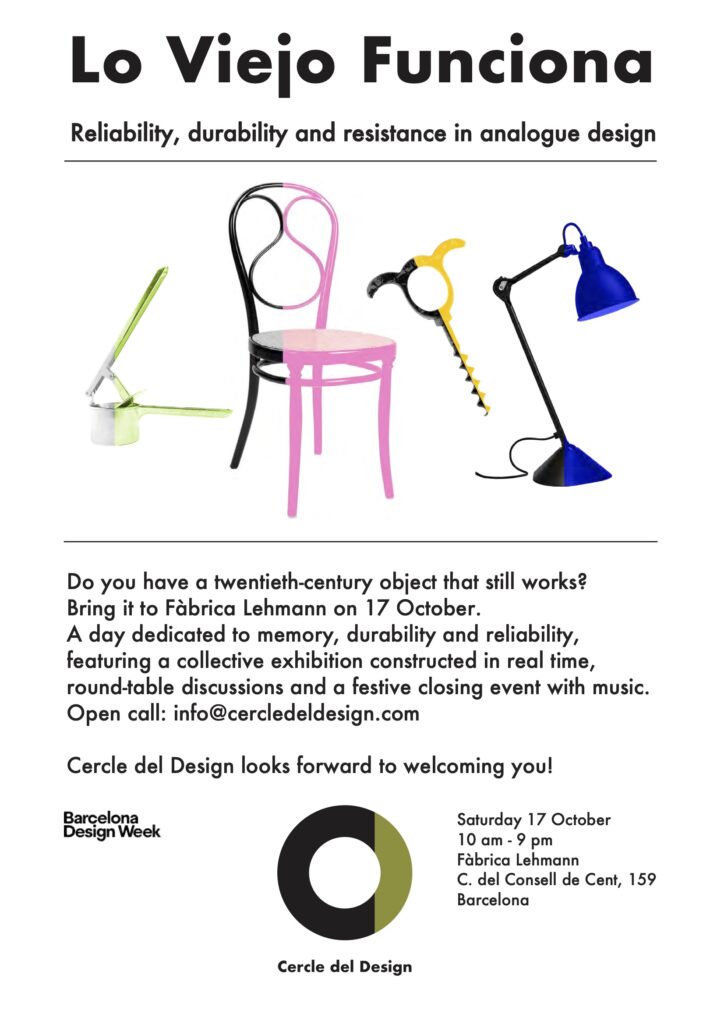
Cercle del Design is launching an open call to create a collective exhibition entitled LO VIEJO FUNCIONA. Reliability, durability and the resilience of analogue design, on Saturday 17 October, from 10 am to 9 pm, in the courtyard of Fàbrica Lehmann, Carrer del Consell de Cent 159, Barcelona.
We are looking for everyday twentieth-century objects that are still working. The collected objects will form the core of a collective exhibition and the starting point for a shared reflection on the reliability, durability and resilience of analogue design.
Cercle del Design invites designers, interior designers and the general public to bring a twentieth-century object that still works: not a museum piece, but an object shaped by time and use. The open call is organised around seven forms of permanence: memory, durability, reliability, repairability, materiality, use and beauty that does not age — different ways of understanding the relationship between use, time and meaning.
The event, which is part of the OFF programme of Barcelona Design Week 2026, is a happening: the objects arrive with their owners, who present them to the public before adding them to the exhibition. Each participant is photographed holding their object with a Fujifilm Instax camera. The resulting instant photograph is added to an exhibition panel, becoming an integral part of the show and the beginning of a digital catalogue of objects and people. The result is an unprecedented and unpredictable installation, constructed in real time.
The project is structured around three areas of debate, with round-table discussions on use, time and meaning: a reflection on the future of design, not only as a source of innovation, but also as a tool for extending the life of objects over time.
The day will conclude with a festive closing event featuring music.
Save the date:
Saturday 17 October, from 10 am to 9 pm
Fàbrica Lehmann
Carrer del Consell de Cent, 159
08015 Barcelona
Cercle del Design is a physical, independent community based in Barcelona and dedicated to contemporary design.
www.cercledeldesign.com
Further information: info@cercledeldesign.com
Guendalina Perelli +34 663 801 384 | guendalina@gwep.it
Jazmín Castresana +34 699 727 665 | jazmin@interiorcontraportada.com
OFF BDW Barcelona Design Week 2026
LO VIEJO FUNCIONA
Reliability, durability and the resilience of analogue design
“Objects that have been used day after day become works of art. Once their patina is touched, and if an attempt is made to restore their original appearance, they lose all their power and spirit. Time gives the material a second skin.” Axel Vervoordt, “Artempo: Where Time Becomes Art” (Palazzo Fortuny, Venice, 2007)
It is said that the perfect chair has already been designed. This statement gives rise to a broader reflection: perhaps this is why “old things work”. Not only because some objects from the past continue to fulfil their
technical function, but because they also work on a deeper level: human, emotional and connected to memory.
An object works when it fulfils the purpose for which it was created, establishing a relationship with the person who uses it. It is an exchange between body, gesture and meaning that goes beyond efficiency.
Objects evoke through their form, weight, surface and material. Memory is one of these channels — immediate and involuntary — but it is not the only one. An object can evoke even without a personal memory: it is enough for it to possess presence, coherence and a recognisable quality.
Use transforms: it modifies form, alters materials and leaves traces. Materials from the past contain a quality that is difficult to design in advance: the capacity to age. Not ageing as deterioration, but as patina, honest wear and evidence of resilience over time. Those who have owned these objects have given them a meaning that goes beyond their function, integrating them into a story.
How much of this evocative power can design recover today? To what extent can an object be conceived with the intention of becoming part of people’s histories, rather than merely responding to an immediate function?
Time, technology and human experience
Our relationship with time has changed profoundly. Digital environments have increased the speed at which we access information, the frequency with which products and services are updated, and the fragmentation of our everyday attention. As a consequence, our collective capacity to think in the long term has weakened in favour of constant novelty.
Human beings, however, continue to develop according to biological rhythms that have not changed at the same pace as technology. We learn, build memories, develop relationships and give meaning to things through processes that require time, repetition and continuity.
Perhaps this is why we continue to feel a special affinity with objects that remain with us for years or even generations. Not only because they work, but because they establish a relationship that is more consistent with our own biological rhythms.
Although we belong to a species whose survival has historically depended on the ability to think in intergenerational terms, the direction we are taking appears increasingly distant from this logic.
PROJECT SUMMARY
LO VIEJO FUNCIONA is a proposal by Cercle del Design that raises a central question for contemporary design: why, in many cases, does what already exists continue to work better than what is new?
Inspired by a line from the series El Eternauta, the project does not offer a nostalgic view of the past, but a critical reflection on reliability, durability and resilience as values in design. The question is not whether old things are better than new ones, but what we can learn from objects that have withstood the passage of time, and how this knowledge can influence contemporary design practice.
In a context shaped by planned obsolescence and digital volatility, choosing what endures — what can be repaired, what has been proven and what withstands the passage of time — becomes both a design and a cultural decision.
The growth of the second-hand market, European right-to-repair legislation and the return to materiality are redefining our relationship with objects.
The project is structured around three areas of debate:
1. USE (how the object lives and functions in the present)
Design dissolves into behaviour. Naoto Fukasawa
Use as the active condition of an object over time.
What enables an object to continue working and to remain recognisable and meaningful in everyday life?
Use is a continuous process that transforms an object through contact with the body, gesture and repetition. Functionality, familiarity and the object’s practical permanence are constructed through this relationship. An object works when it establishes a relationship with the person who uses it: an exchange that goes beyond efficiency. Familiarity means that we do not have to learn new systems constantly, while continuity of use generates a form of everyday stability. In this context, the proliferation of digital updates and the accelerated replacement of products have changed our relationship with use, fragmenting experience and weakening the continuity of gesture.
2. TIME (how the object changes and ages)
The object is not merely a function. It is a story. Ettore Sottsass
Time as a material of design.
How do objects age? What does it mean for a material to “age well”?
This area explores the relationship between materiality, durability and transformation. It is not concerned with deterioration understood as loss, but with an object’s capacity to incorporate the passage of time as a value: patina, honest wear, traces of use and the beauty of accumulated imperfection.
In contrast to the contemporary logic of planned obsolescence and technological acceleration, many analogue objects continue to demonstrate an increasingly rare quality: the ability to remain operational for decades.
At the same time, our relationship with time has changed profoundly. Digital environments have accelerated update cycles and diminished the importance of the long term. Our biological rhythms, memory, learning and the formation of relationships, however, still depend on slow, repetitive and continuous processes.
Perhaps this is why we continue to feel an affinity with objects that remain with us for years or generations: not only because they work, but because they are aligned with our own human sense of time.
3. MEANING (why the object endures and acquires value)
Have nothing in your house that you do not know to be useful, or believe to be beautiful. William Morris
The object as a bearer of memory, value and cultural resilience.
What allows an object to transcend its function? How is its symbolic, emotional and economic dimension constructed?
This area approaches the object as a repository of individual and collective memory. Evocation does not depend exclusively on personal recollection: an object need only possess presence, material coherence and a recognisable quality to activate different forms of meaning.
Prolonged use transforms an object: it modifies its form, alters its materials and leaves traces. Many objects from the past thus acquire a narrative dimension that goes beyond their original function, becoming repositories of stories, affections and relationships.
Within this framework, multiple layers of meaning emerge: family memory, remembrance and nostalgia, rarity as a cultural value, familiarity as a source of security, the aesthetics of permanence, and the economic value derived from scarcity and time.
In this context, repair is not merely a technical action, but a cultural act that reintroduces continuity into a system dominated by obsolescence.
The growth of the second-hand market and the right to repair reinforce this reinterpretation of the object as a durable and recoverable entity.
LO VIEJO FUNCIONA does not offer a nostalgic view of the past, but an invitation to observe what has withstood the passage of time and to rethink the future of design through the logics of use, time and meaning.
The question is not only why old things continue to work, but whether we are designing today’s objects to continue working fifty years from now.
Dieter Rams, German designer:
“Design should aspire to timelessness instead of following trends.”
“I always strive to create sustainable things. By this I mean durable products, products that do not age prematurely and do not go out of fashion.”
Open call + collective exhibition
Saturday 17 October, from 10 am to 9 pm
Fàbrica Lehmann
Carrer del Consell de Cent, 159
08015 Barcelona
www.cercledeldesign.com
Further information: info@cercledeldesign.com
Guendalina Perelli +34 663 801 384 | guendalina@gwep.it
Jazmín Castresana +34 699 727 665 | jazmin@interiorcontraportada.com
“`